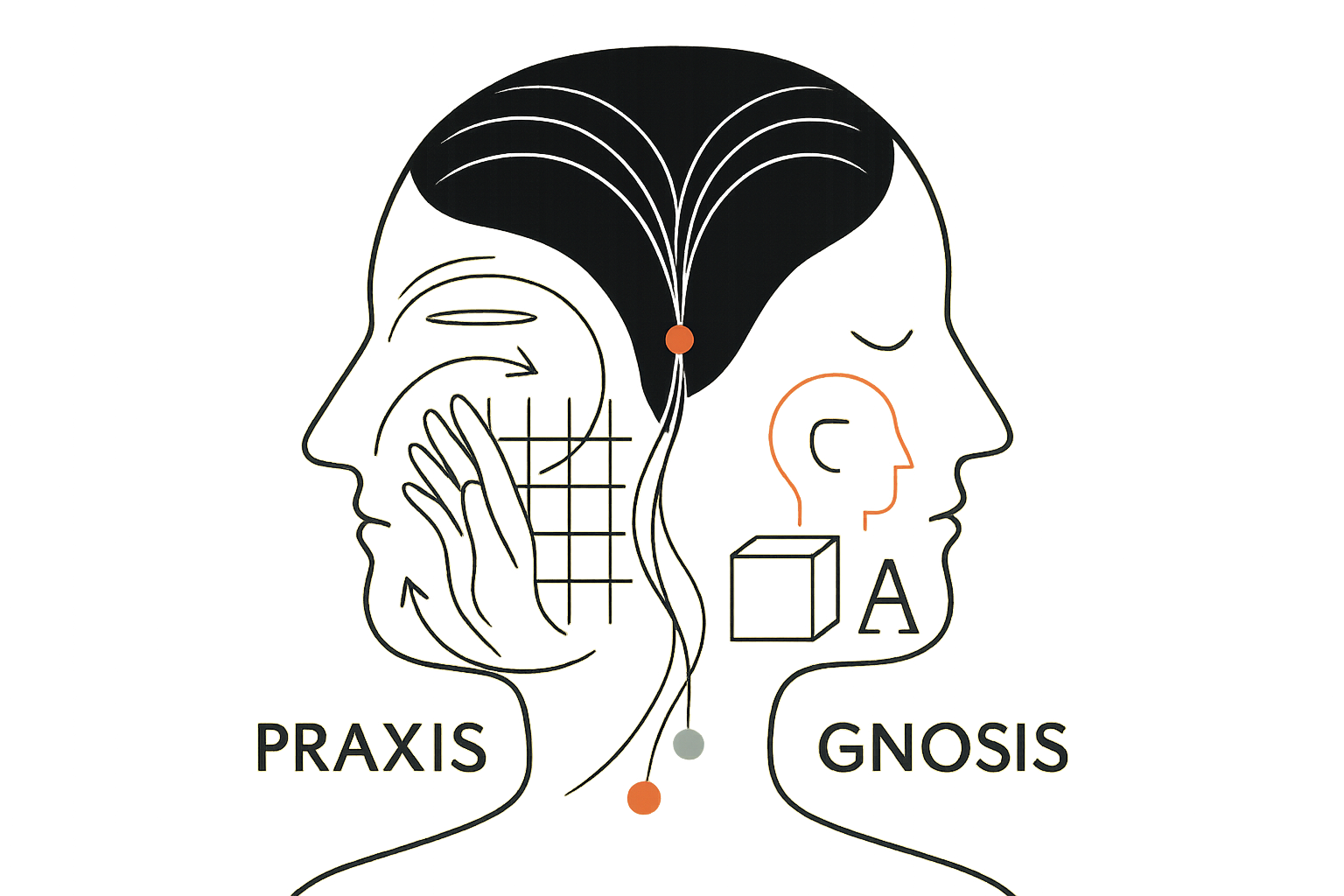
1) Etymology and First Uses
Agnosia originates from the Greek a- ("without") + gnosis ("knowledge"); Freud formalized the term in Zur Auffassung der Aphasien (1891). Apraxia comes from a- + praxis ("action/doing"); the label entered medical German in the late 19th century and was systematized by Liepmann in the early 1900s. These roots matter: agnosias deny access to meaning; apraxias sever intention from execution.
Origins of the Ideas: Lissauer’s 1890 analysis of "Seelenblindheit" proposed apperceptive vs associative visual agnosia - a split that still organizes clinicopathology. Liepmann then delineated ideomotor, ideational, and limb-kinetic apraxias, arguing for a left-hemisphere action network bridging posterior representations and frontal programs. Geschwind later reframed both families as "disconnection" syndromes.
2) From Single Lesions to Systems: The Modern Scaffold
The two-visual-streams account - ventral ("what") for perception/recognition and dorsal ("how/where") for action - explains why agnosias and apraxias often co-travel yet dissociate. This architecture generalizes beyond vision, with dorsal-ventral specializations replicated in language and praxis networks.
Large-scale intrinsic networks provide the disease-era context: the default-mode network (DMN) is preferentially involved in Alzheimer-spectrum disease, whereas the salience network (SN; anterior insula/dorsal ACC) is targeted in behavioral-variant frontotemporal dementia (bvFTD). These network targets predict symptom families - mnemonic/visuospatial agnosias in DMN diseases; socio-emotional and executive "apraxias of behavior" in SN diseases.
3) Agnosias: What Is Perceived vs What Is Known
Visual:
-
Apperceptive vs Associative: Lissauer’s split remains useful at bedside and in imaging. Apperceptive cases fail early shape integration; associative cases copy but cannot link to stored meaning.
-
Subtypes: Prosopagnosia (faces), alexia without agraphia (word-specific), achromatopsia (color), akinetopsia (motion), simultanagnosia (scene integration) map to ventral or dorsal stream injury, often with ILF/IFOF disconnection.
Auditory:
-
Auditory Verbal Agnosia (Pure Word Deafness): Disproportionate failure to understand speech with relatively spared non-speech sound recognition; typically involves bilateral or dominant temporal pathways.
-
Phonagnosia: Inability to recognize familiar voices; developmental and acquired forms underscore modality-specific person knowledge.
-
Environmental Sound Agnosia: Selective difficulty with non-speech sounds, occasionally seen in AD.
Somatosensory:
-
Tactile Agnosia/Astereognosis: Object recognition fails by touch despite intact primary sensation; classic with parietal lesions and dissociable from gross sensory loss.
Body/Space Knowledge:
-
Autotopagnosia: Breakdown of the body schema - identifying or localizing body parts - classically with left parietal involvement.
4) Apraxias: Intention, Selection, Sequencing, and Control
Canonical Limb Apraxias:
-
Ideomotor: Gesture imitation and pantomime are disordered despite understanding the command.
-
Ideational: Multistep tool sequences collapse (order, object selection).
-
Limb-Kinetic: Loss of deft, fractionated movements. Lesion-symptom mapping and meta-analyses implicate a left parietal-anchored praxis network with fronto-parietal and callosal connectors.
Constructional and Visuomotor Apraxias: Difficulty copying/drawing or assembling shapes links dorsal stream and right parietal hubs, and often co-occurs with neglect or Balint features.
Oculomotor and Optic Apraxias: In Balint’s syndrome, defective goal-directed gaze (oculomotor "apraxia") and reach (optic ataxia) emerge from bilateral occipitoparietal injury - prototypical "how" pathway failure.
Apraxia of Speech (AOS): In degenerative syndromes, a primary progressive AOS phenotype centers on left premotor/SMA and frontal insula networks; in nfvPPA, white-matter damage to speech production tracts is prominent.
White-Matter Foundations: Modern tractography shows praxis depends on a distributed graph; disruptions within SLF/ILF/IFOF predict gesture, tool-use, and naming deficits, integrating the disconnection tradition with network neuroscience.
5) Diagnosing by Mixtures: Mapping Syndromes onto Agnosia x Apraxia
Posterior Cortical Atrophy (PCA, Alzheimer Phenotype): Early visuoperceptual and spatial agnosias (simultanagnosia, alexia, object/form), constructional apraxia, and optic ataxia reflect dorsal-ventral posterior network compromise within the DMN/visuospatial systems.
Primary Progressive Aphasia (PPA):
-
Semantic Variant (svPPA): An "associative agnosia" of concepts - especially for objects and faces - driven by anterior temporal network degeneration.
-
Logopenic Variant (lvPPA): Phonologic working-memory breakdown (often AD-related) with posterior perisylvian/DMN involvement.
-
Nonfluent/Agrammatic (nfvPPA): Motor-speech planning (AOS) and grammatical "praxis" impairments of sequencing, with dorsal frontal-insular network injury. Consensus criteria and imaging operationalize these subtype mixtures.
Behavioral-Variant Frontotemporal Dementia (bvFTD): Early salience-network degeneration and selective loss of frontoinsular von Economo neurons produce a social-executive praxis failure - goal selection, switching, and inhibition collapse - plus a social agnosia for others’ internal states. This explains disinhibition/apathy without primary amnesia or aphasia in early stages.
Why the Mixtures Recur: Healthy connectomes predict where degeneration spreads: disease-specific seeds erode connected networks ("network-based vulnerability"), yielding reproducible agnosia/apraxia cocktails rather than arbitrary symptom lists.
6) A Modality-Anchored Diagnostic Grammar (Bedside → Networks)
Visual Domain:
-
Agnosia Axis: apperceptive (early shape integration; occipito-parietal/ventral entry) → associative (link to semantics; ventral temporal + ILF/IFOF).
-
Apraxia Axis: constructional, optic ataxia, ocular "apraxia" (bilateral parietal).
Auditory Domain:
-
Agnosia Axis: word deafness ↔ phonagnosia ↔ environmental sound agnosia (superior temporal and voice-selective pathways).
-
Apraxia Axis: orobuccal praxis and speech-motor planning (AOS) (left frontal-insular).
Somatosensory/Body Schema:
-
Agnosia Axis: tactile agnosia/astereognosis; autotopagnosia.
-
Apraxia Axis: limb-kinetic and ideomotor failures (left IPL and connectors).
Social-Executive:
-
Agnosia Axis: blunted interoceptive/affective signal recognition ("social agnosia").
-
Apraxia Axis: disinhibition, utilization behavior, and set-shifting failure ("executive praxis"). These flow from salience-network and frontoinsular pathology.
7) How This Reframing Helps
-
Cognitive Ecology: Instead of "is this aphasia or apraxia?" we ask: along which agnosia/apraxia axes - and in which modality - does the patient fail? This reduces pseudo-dissociations created by task design and foregrounds multimodal convergence.
-
Anatomical Precision: Grouping deficits by axis predicts tract involvement (e.g., ILF for visual associative agnosia; SLF/IFOF for praxis/tool use; premotor/SMA for AOS), guiding imaging readouts and neuromodulation targets.
-
Neurodegenerative Patterning: The "mixture" view anticipates the characteristic blends in PCA (visual agnosia + constructional/optic apraxia), nfvPPA (AOS + grammatical sequencing), svPPA (conceptual agnosia), and bvFTD (social-executive praxis collapse).
-
Trial Endpoints: Axis-specific composites (e.g., a praxis battery aligned to dorsal fronto-parietal connectivity; a multimodal agnosia index aligned to ventral streams) may be more sensitive than omnibus cognitive screens for early-stage change. (Conceptual inference from the cited network and tractography literature.)
8) Limitations and Scope
Not all phenomena reduce cleanly to agnosia/apraxia. Primary arousal disorders, primary motor unit disease, or diffuse subcortical states can mimic these axes. Even within the cortex, neglect’s motor-intentional and perceptual-attentional components straddle our taxonomy. Our claim is pragmatic: for cortical syndromes, an agnosia x apraxia grammar offers high coverage and mechanistic traction.
Methods Note (Sources and Historiography)
Foundational sources include Freud (1891) on agnosia, Lissauer (1890) on agnosia subtypes, Liepmann (1900-1908) on apraxias, and Geschwind (1965) on disconnection. Modern scaffolding draws on dual visual streams and intrinsic network models (DMN, SN). Subtype-specific evidence comes from lesion-symptom mapping, tractography, and consensus criteria (e.g., PPA).
Selected References (Representative)
- Freud S. Zur Auffassung der Aphasien (1891) - coined "agnosia."
- Lissauer H. (1890) - apperceptive vs associative agnosia.
- Liepmann H. (1900-1908) - ideomotor/ideational/limb-kinetic apraxias.
- Geschwind N. (1965) - disconnection syndromes.
- Goodale & Milner (1992) - perception-action streams.
- Raichle/DMN and Buckner et al. (2005-2015) - network targets in AD.
- Seeley et al. (2007, 2009-2013) - salience network; VEN vulnerability in bvFTD.
- Gorno-Tempini et al. (2011) - PPA classification consensus.
- Mandelli et al. (2014), Josephs et al. (2013) - AOS/nfvPPA tract and gray-matter correlates.
- Rosenzopf et al. (2022) - praxis disconnection network.
- Crutch et al. (2012) - PCA review.